
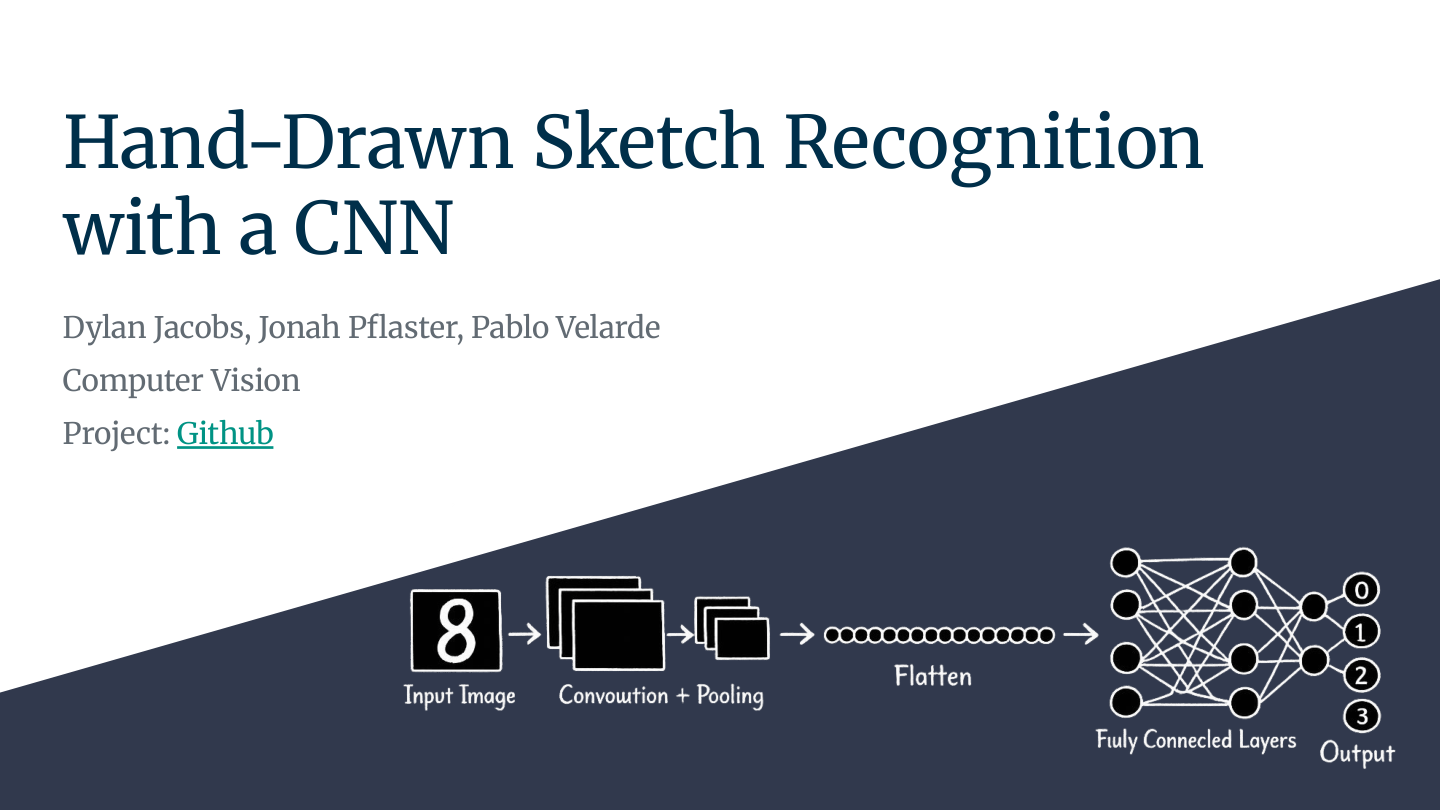
Hand-Drawn Image Classification Using a Convolutional Neural Network
Date:
Author: Dylan Jacobs
Project: Github
Interactive project demonstration: Click here to try out the model yourself!!
Slide 1
Slide 2
Project Scope
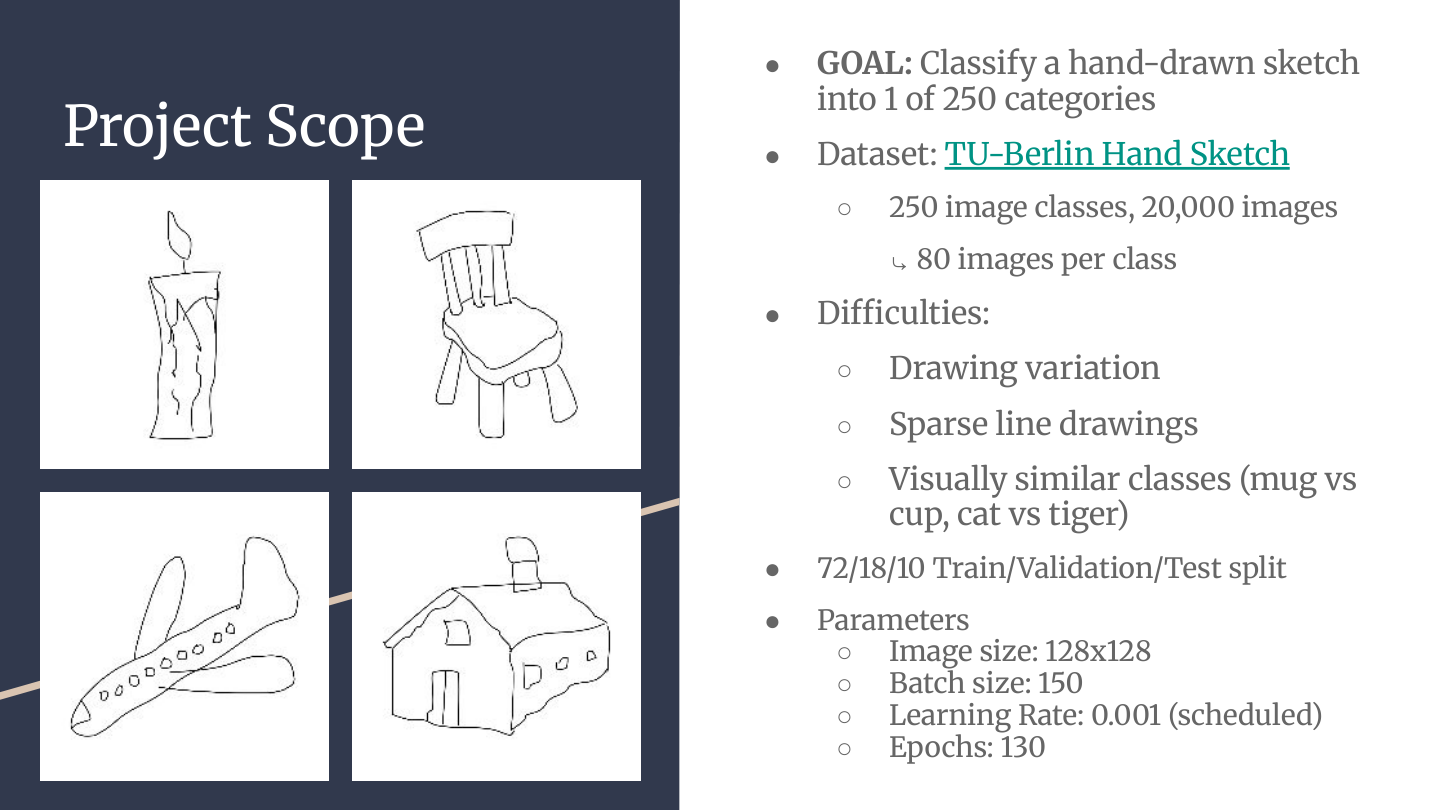
- GOAL: Classify a hand-drawn sketch into 1 of 250 categories
- Dataset: TU-Berlin Hand Sketch
- 250 image classes, 20,000 images
⤷ 80 images per class
- 250 image classes, 20,000 images
- Difficulties:
- Drawing variation
- Sparse line drawings
- Visually similar classes (mug vs cup, cat vs tiger)
- 72/18/10 Train/Validation/Test split
- Parameters:
- Image size: 128x128
- Batch size: 150
- Learning Rate: 0.001 (scheduled)
- Epochs: 130
Slide 3
Model Architecture
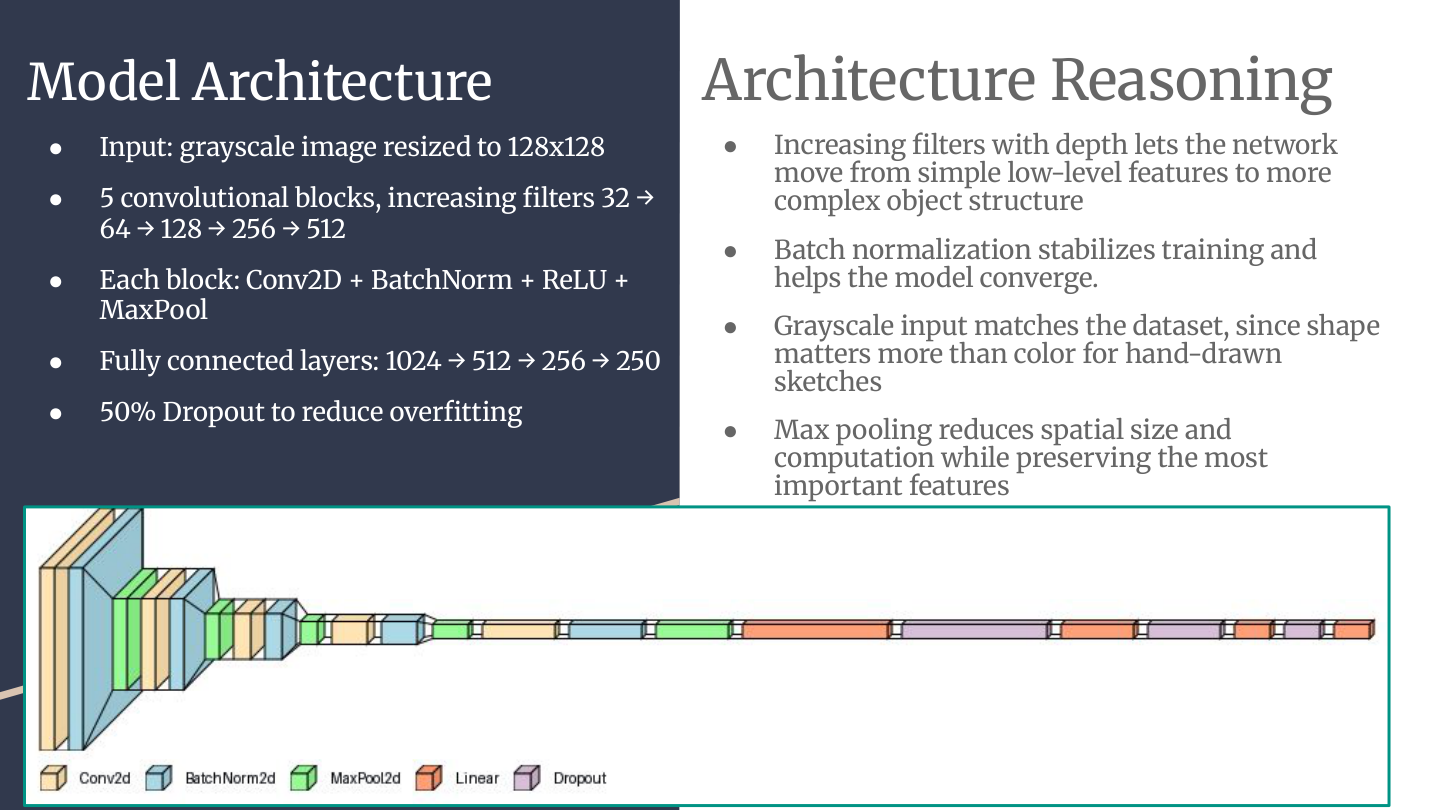
- Input: grayscale image resized to 128x128
- 5 convolutional blocks, increasing filters 32 → 64 → 128 → 256 → 512
- Each block: Conv2D + BatchNorm + ReLU + MaxPool
- Fully connected layers: 1024 → 512 → 256 → 250
- 50% Dropout to reduce overfitting
Architecture Reasoning
Increasing filters with depth lets the network move from simple low-level features to more complex object structure
- Batch normalization stabilizes training and helps the model converge.
- Grayscale input matches the dataset, since shape matters more than color for hand-drawn sketches
- Max pooling reduces spatial size and computation while preserving the most important features
Slide 4
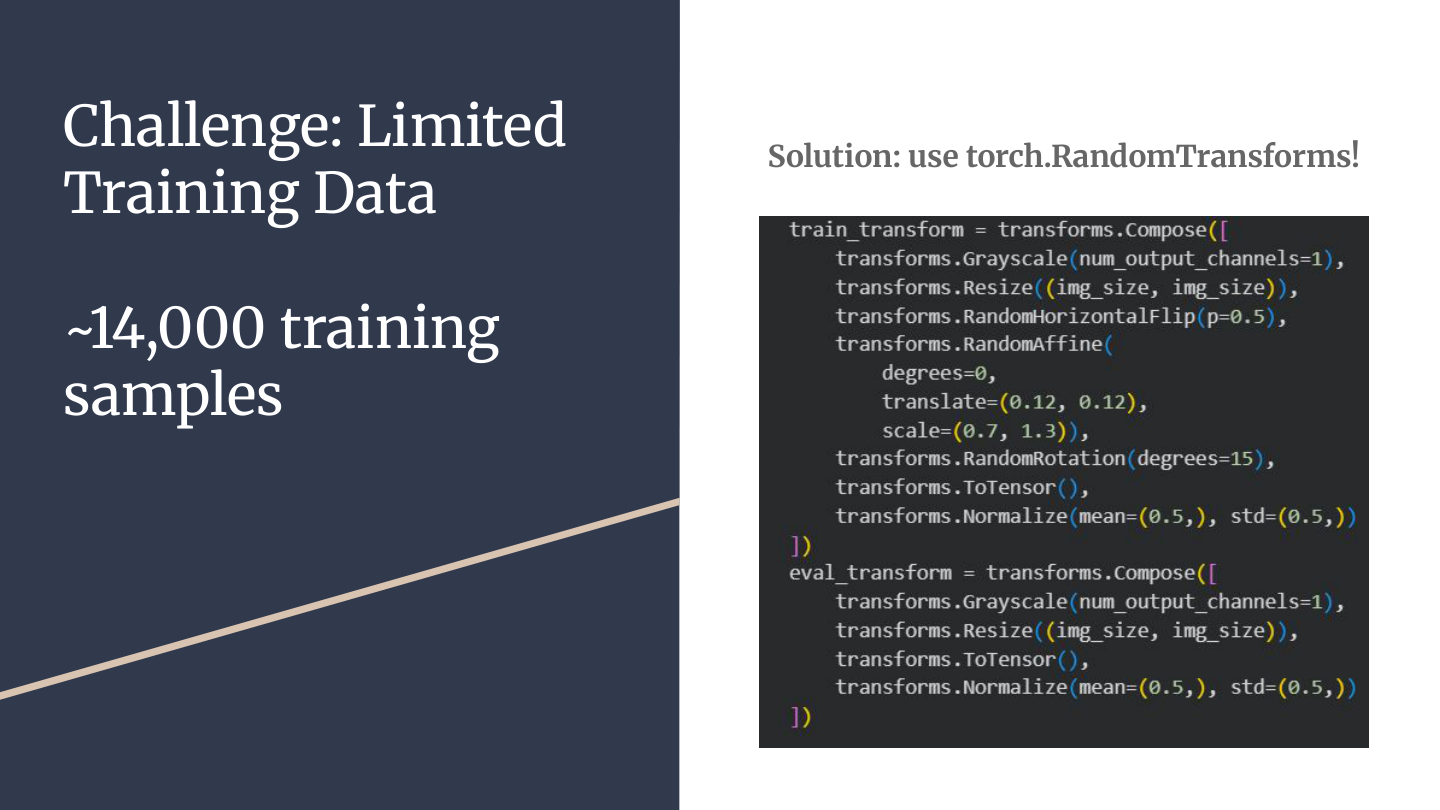
Challenge: Limited Training Data
~14,000 training samples
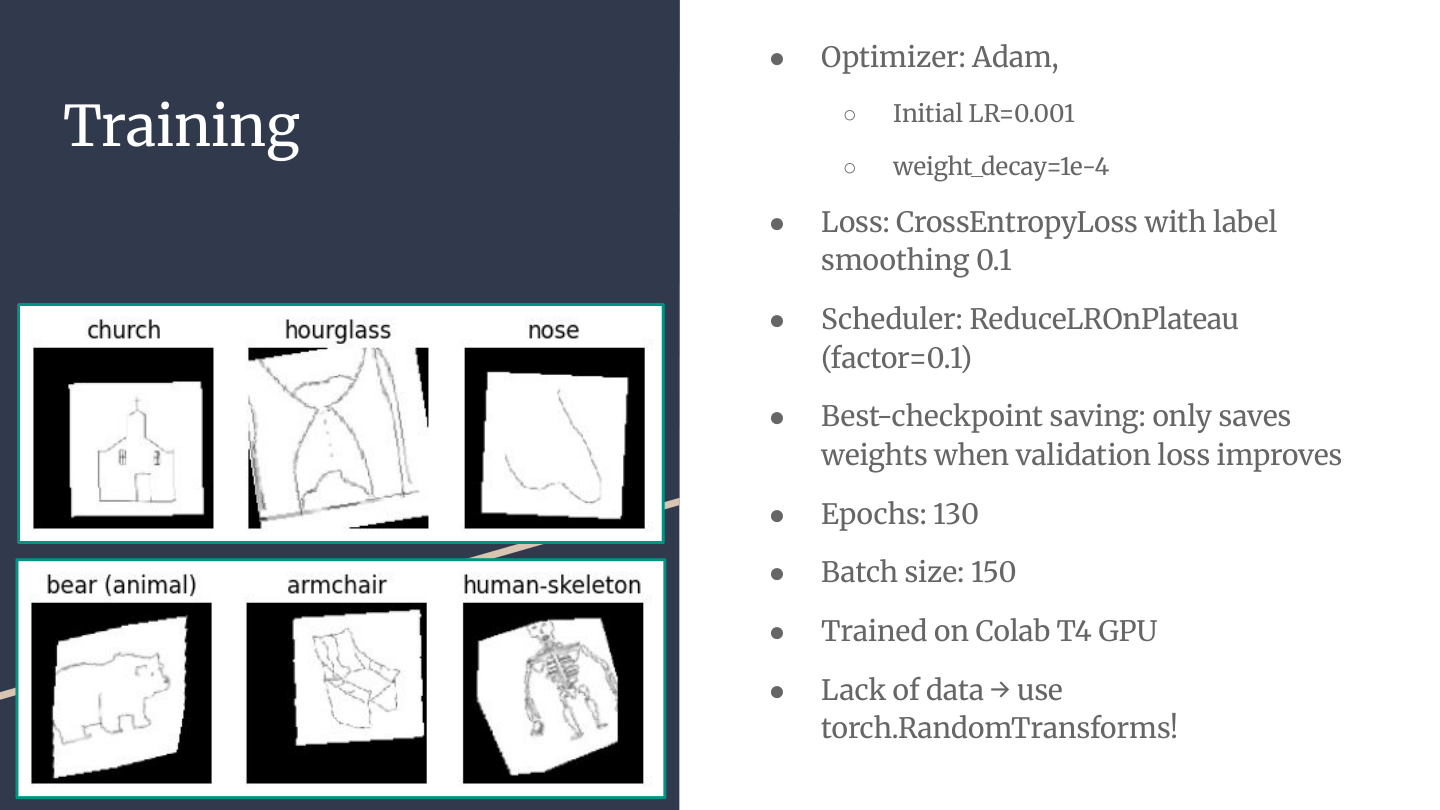
Solution: use torch.RandomTransforms!
Slide 5
Training
- Optimizer: Adam
- Initial LR=0.001
- weight_decay=1e-4
- Loss: CrossEntropyLoss with label smoothing 0.1
- Scheduler: ReduceLROnPlateau (factor=0.1)
- Best-checkpoint saving: only saves weights when validation loss improves
- Epochs: 130
- Batch size: 150
- Trained on Colab T4 GPU
- Lack of data → use torch.RandomTransforms!
Slide 6
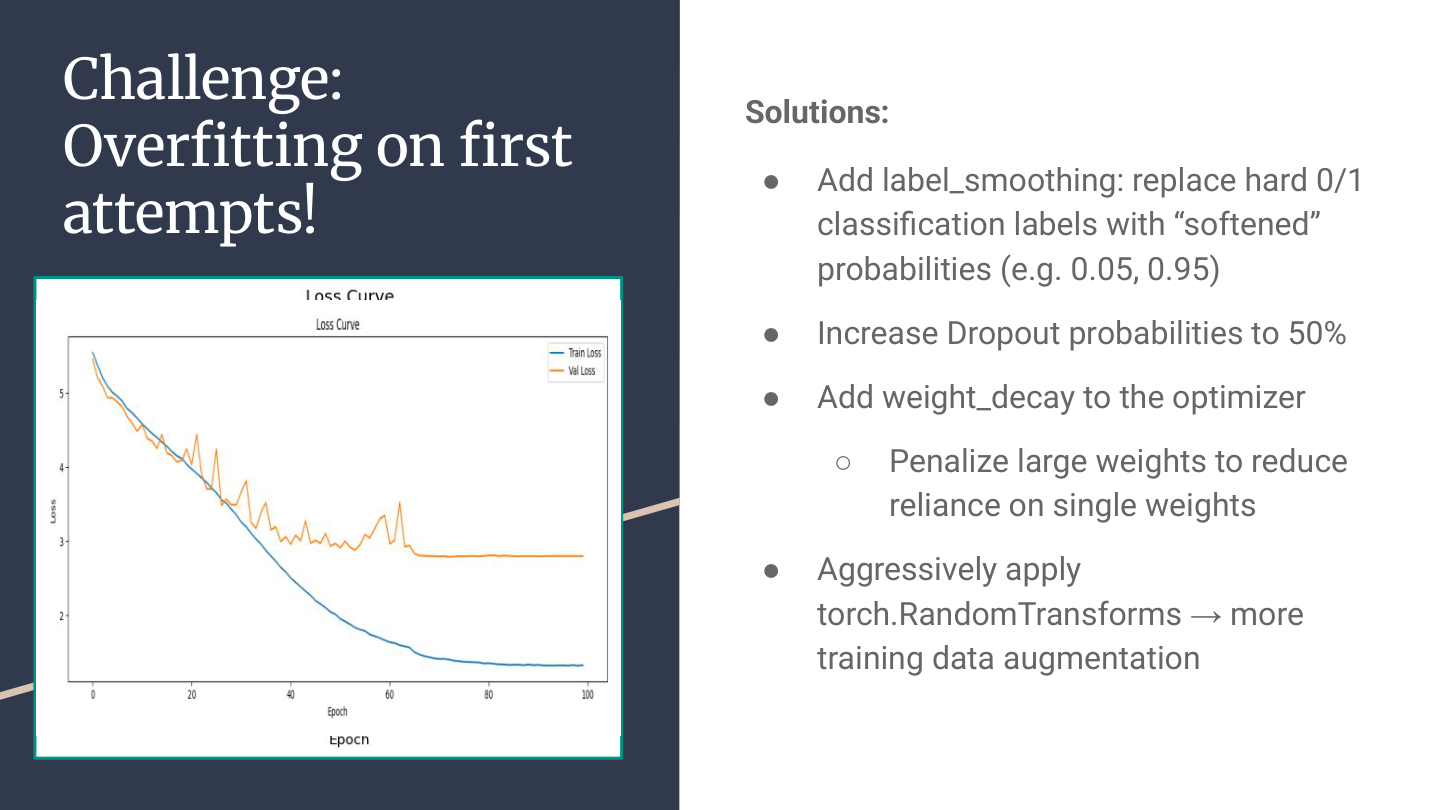
Challenge: Overfitting on first attempts!
Solutions:
- Add label_smoothing: replace hard 0/1 classification labels with “softened” probabilities (e.g. 0.05, 0.95)
- Increase Dropout probabilities to 50%
- Add weight_decay to the optimizer
- Penalize large weights to reduce reliance on single weights
- Aggressively apply torch.RandomTransforms → more training data augmentation
Slide 7
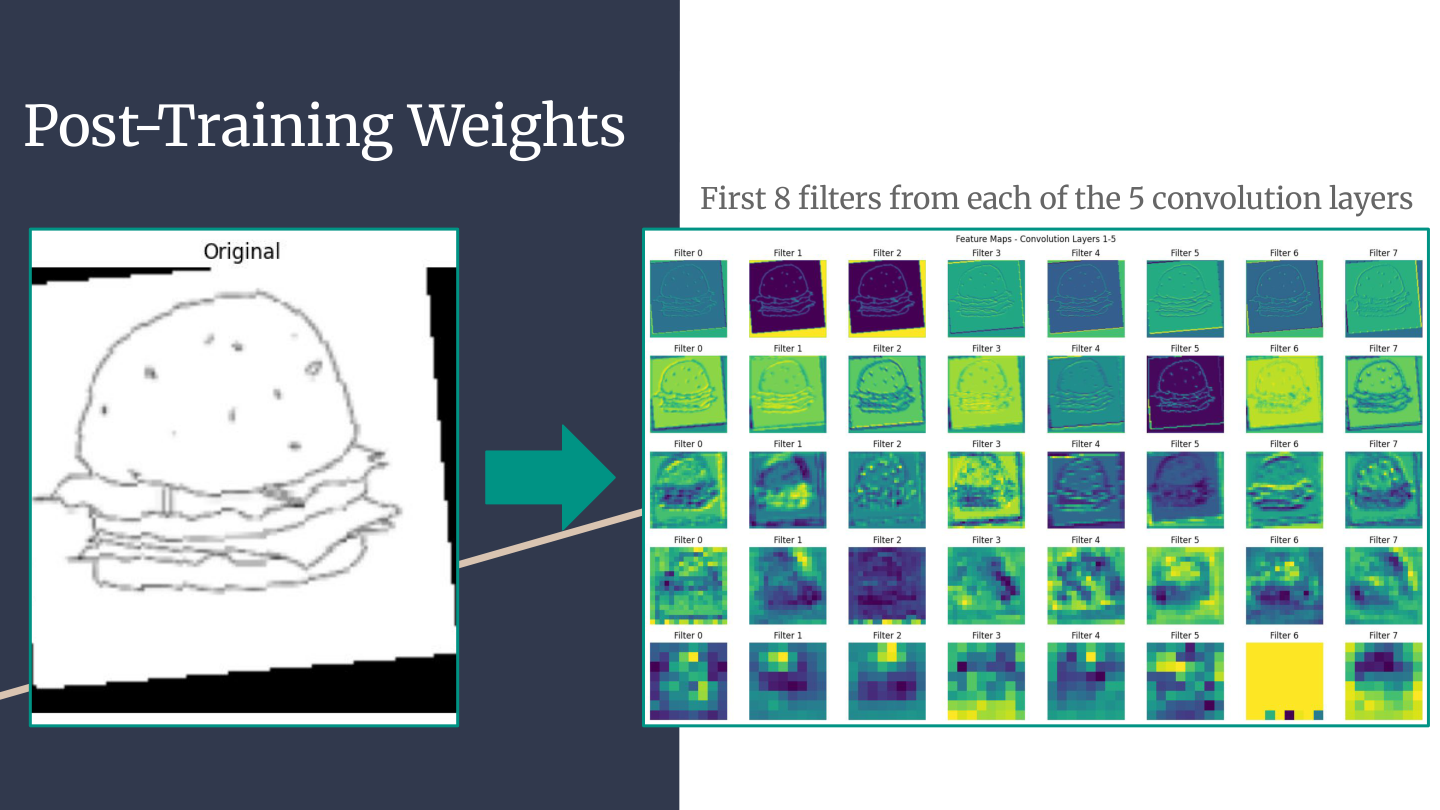
Post-Training Weights
First 8 filters from each of the 5 convolution layers
Slide 8
Results
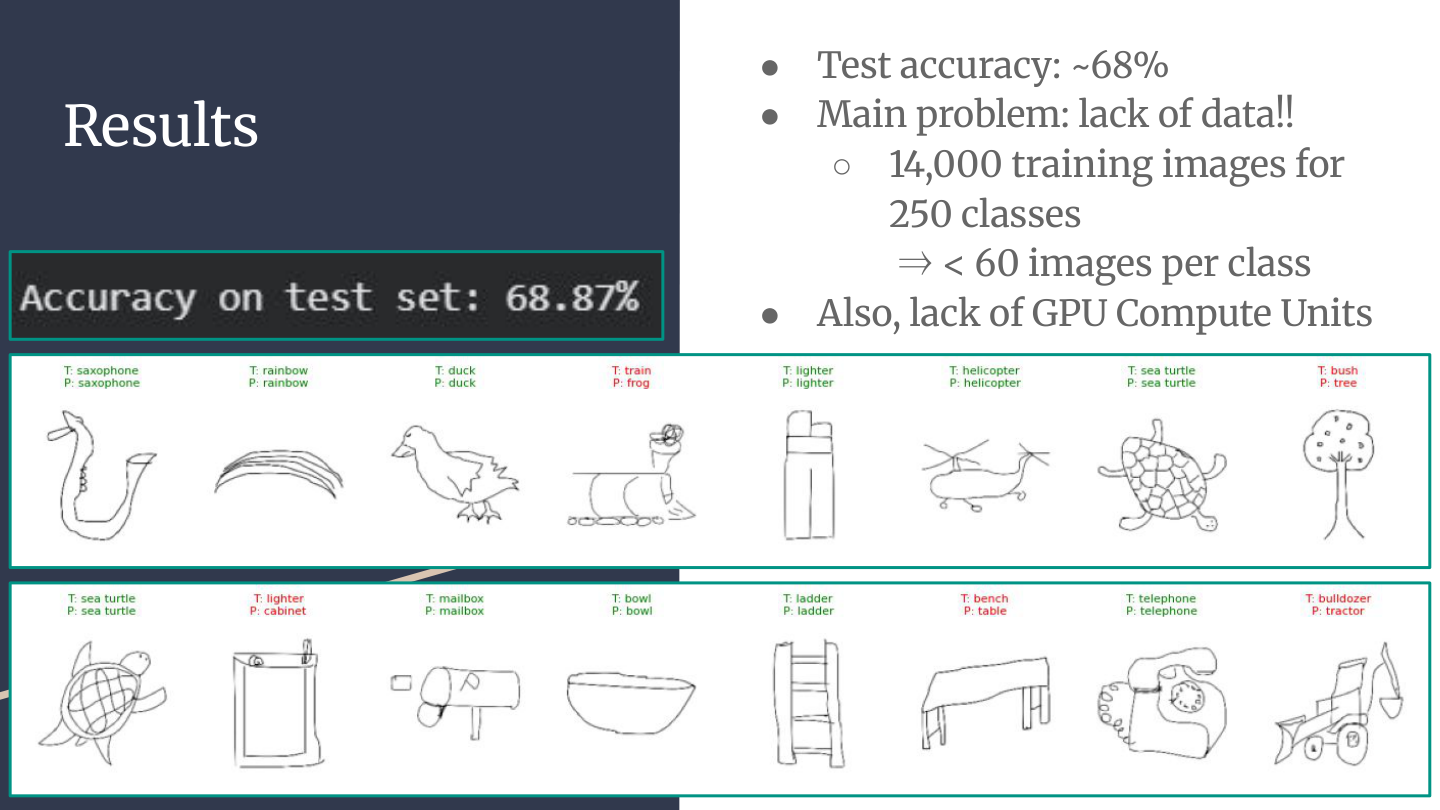
- Test accuracy: ~68%
- Main problem: lack of data!!
- 14,000 training images for 250 classes ⇒ < 60 images per class
- Also, lack of GPU Compute Units
Slide 9
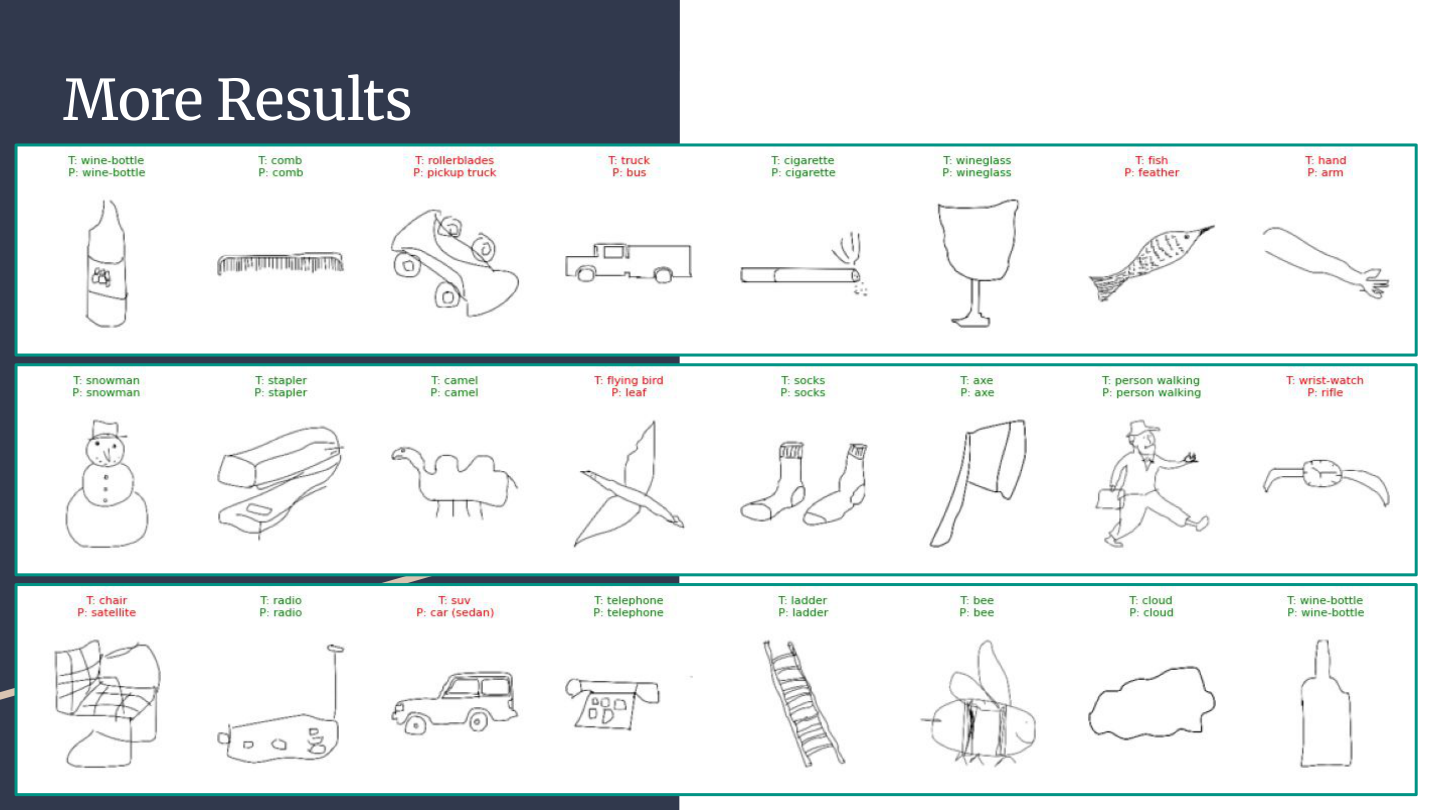
More Results
Slide 10
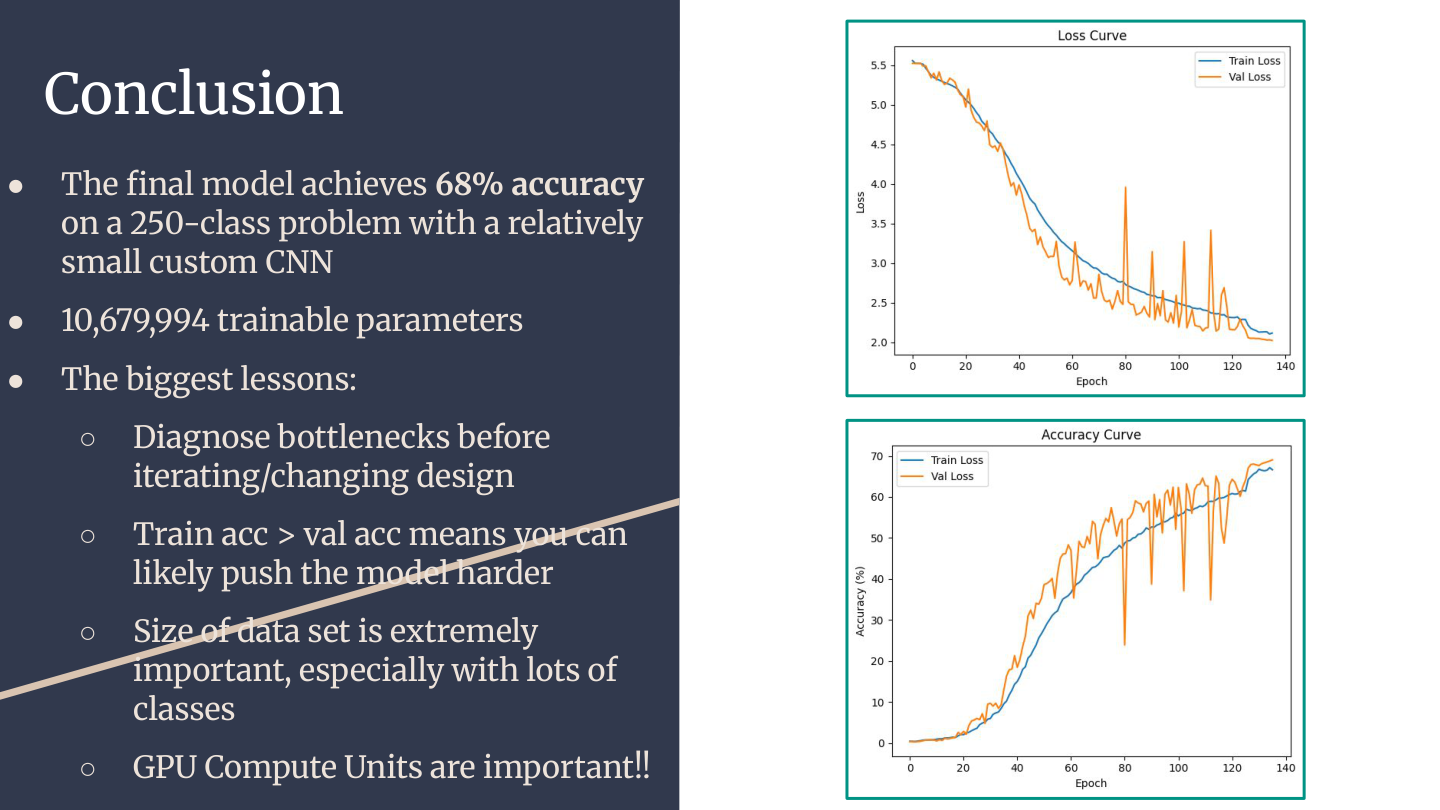
Conclusion
- The final model achieves 68% accuracy on a 250-class problem with a relatively small custom CNN
- 10,679,994 trainable parameters
- The biggest lessons:
- Diagnose bottlenecks before iterating/changing design
- Train acc > val acc means you can likely push the model harder
- Size of data set is extremely important, especially with lots of classes
- GPU Compute Units are important!!